
Following the Dragon’s Back
Art, dowsing and the living landscape of Bodmin Moor
What happens when we spend long enough with a landscape that we begin to see it differently? Artist and dowser Pete Bousfield has spent more than twenty years exploring the eastern edge of Bodmin Moor, following geology, water, ancient sites, earth energies and, eventually, the shape of a dragon.
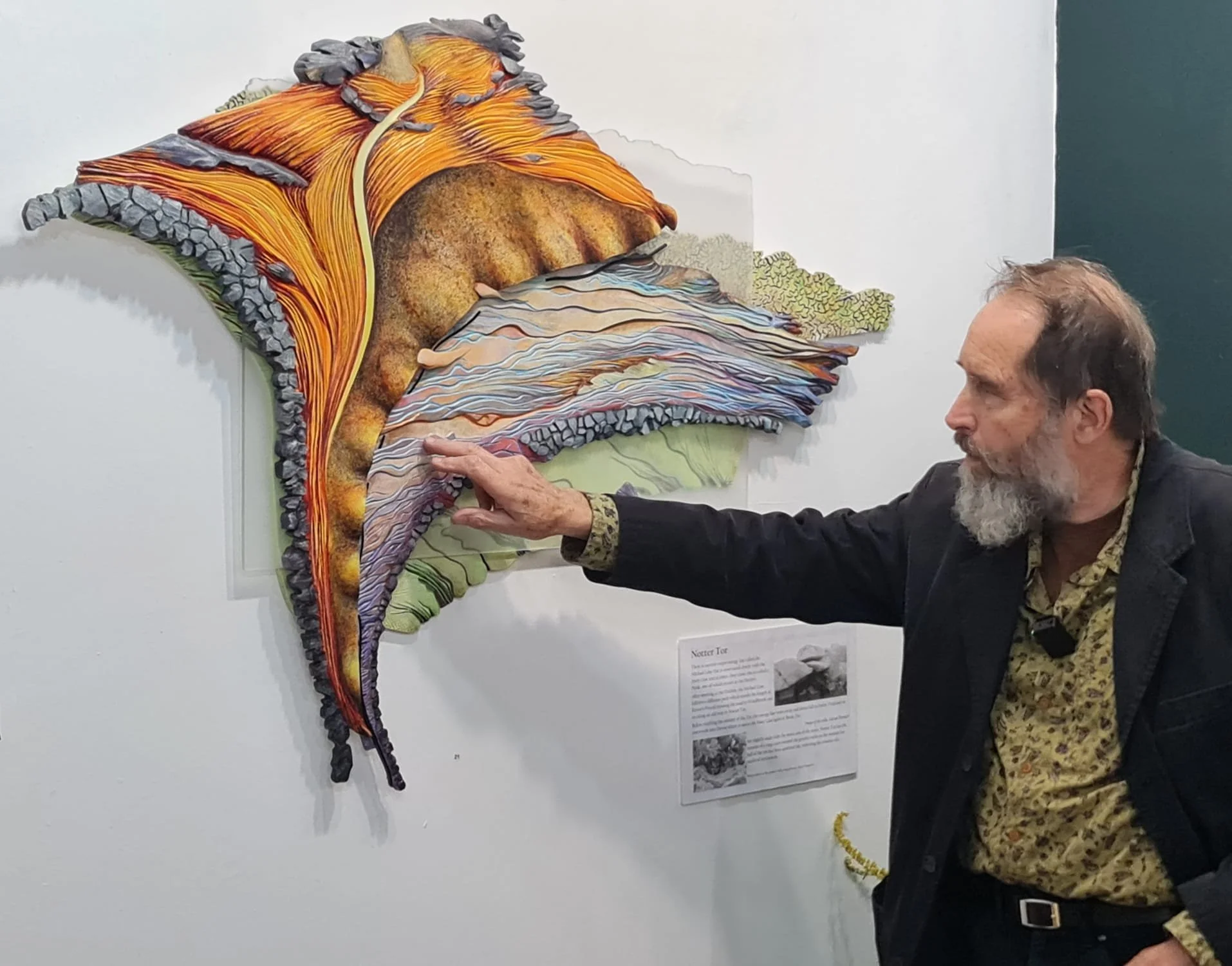
Artist Pete Bousfield with one of the works from The Dragon’s Back - and other stories at Terre Verte Gallery, Altarnun.
Every so often, a talk comes along that seems to land right in the middle of several things you have already been thinking about. Pete Bousfield’s recent talk to Tamar Dowsers was one of those for me.
His work brings together art, landscape, dowsing, geology, ancient places and, rather wonderfully, dragons. Not dragons in the obvious mythical sense, but dragons that seem to emerge from the shape and character of the land itself.
That immediately caught my attention.
I have become increasingly fascinated by the way dragon imagery appears again and again in landscapes, old stories and energetic traditions. Sometimes the connection is explicit. Sometimes it survives in a place name or local story. And sometimes you look across the land and suddenly see a form that was somehow there all along.
A ridge becomes a spine. A tor becomes a head. The landscape begins to feel less like scenery and more like something alive.
Once you have seen the dragon, it can be surprisingly difficult to unsee it.
Spending long enough with a place
Pete has spent more than twenty years exploring East Cornwall and the eastern side of Bodmin Moor, and I think that length of relationship matters.
There is a real difference between visiting a place and getting to know it.
When we first arrive somewhere, we notice the obvious things: a tor, a stone circle, a river, a view. But when we return again and again, other relationships begin to reveal themselves. We notice how one ridge sits in relation to another, where the water flows, where the geology changes, and how ancient sites sit within the wider landscape.
Pete has explored this area through walking, drawing, research and dowsing. Over time, those different ways of looking seem to have begun speaking to one another.
That was one of the things I most enjoyed about his talk. Nothing felt as though it had been put into a separate box. The geology was not separate from the dowsing. The dowsing was not separate from the drawing. The ancient sites were not simply dots on a map.
Instead, there was a sense of following threads.
Or perhaps following the dragon.
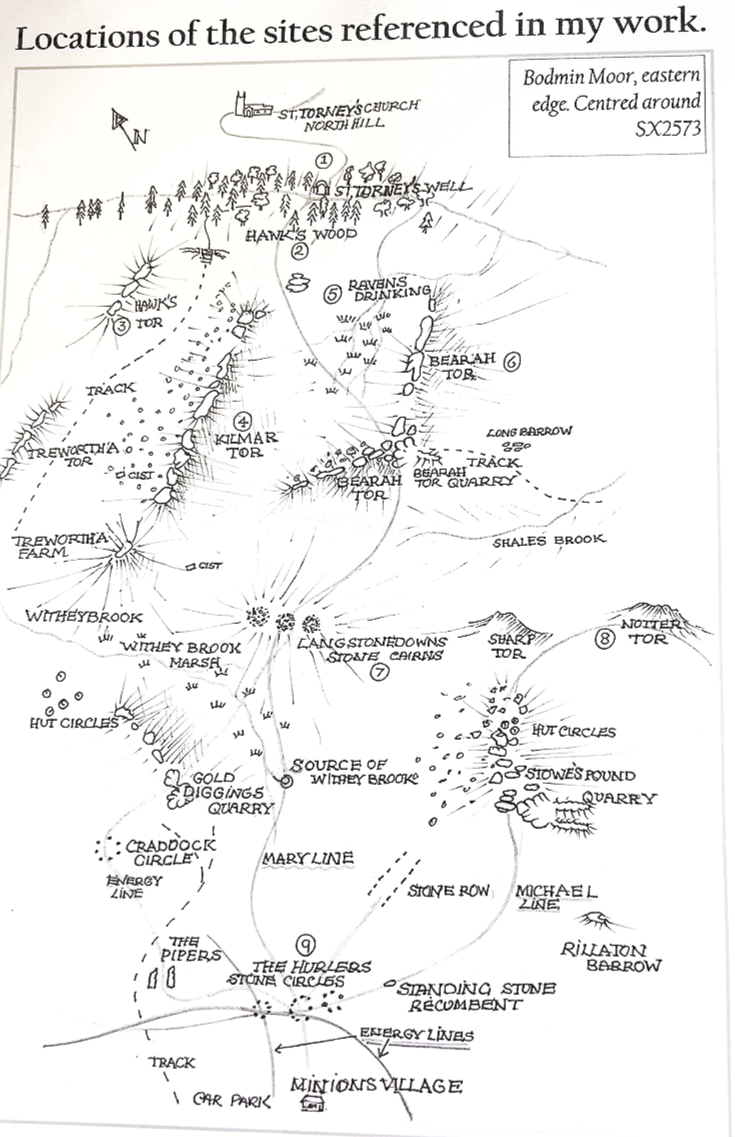
Pete’s map of the eastern edge of Bodmin Moor, showing some of the places, landscape features and dowsed energy lines that have informed his work.
Following the line through the landscape
Looking at Pete’s map makes this much easier to understand because you can begin to follow the relationships for yourself.
At the top are St Torney’s Church and St Torney’s Well. Moving south through the landscape are Hawks Wood, Hawk’s Tor, Kilmar Tor, Raven’s Drinking and Bearah Tor. Further down are Langstone Downs, Notter Tor and eventually The Hurlers.
Pete also marks what he identifies through his dowsing as the Mary Line, along with the Michael Line and other energetic features.
It immediately invites a slightly different way of looking at an ancient site.
Instead of only asking, What is significant about this place?, we can begin asking:
What is it connected to?
Where does the water travel? What lies over the next ridge? Is there a geological relationship between these places? Does a dowsed line continue beyond the site we are standing in?
And what happens when we stop thinking of individual sacred or ancient places as isolated objects and begin seeing them as parts of a much wider landscape?
For me, this is where dowsing becomes especially interesting. It does not necessarily have to provide a finite answer. Sometimes it simply gives us another question to follow.
Drawing as a way of listening
Pete’s work began with drawing, which feels significant in itself because drawing makes us slow down.
You cannot really draw a landscape without paying attention to it. You start noticing shape, line, texture, proportion, shadow and distance. Things that might have disappeared into the background suddenly become important.
Over time, Pete’s drawings began to incorporate more than what was immediately visible. Geological structures, waterways, ancient sites and information gathered through dowsing all began to find their way into the work.
Eventually, those drawings moved into three dimensions.
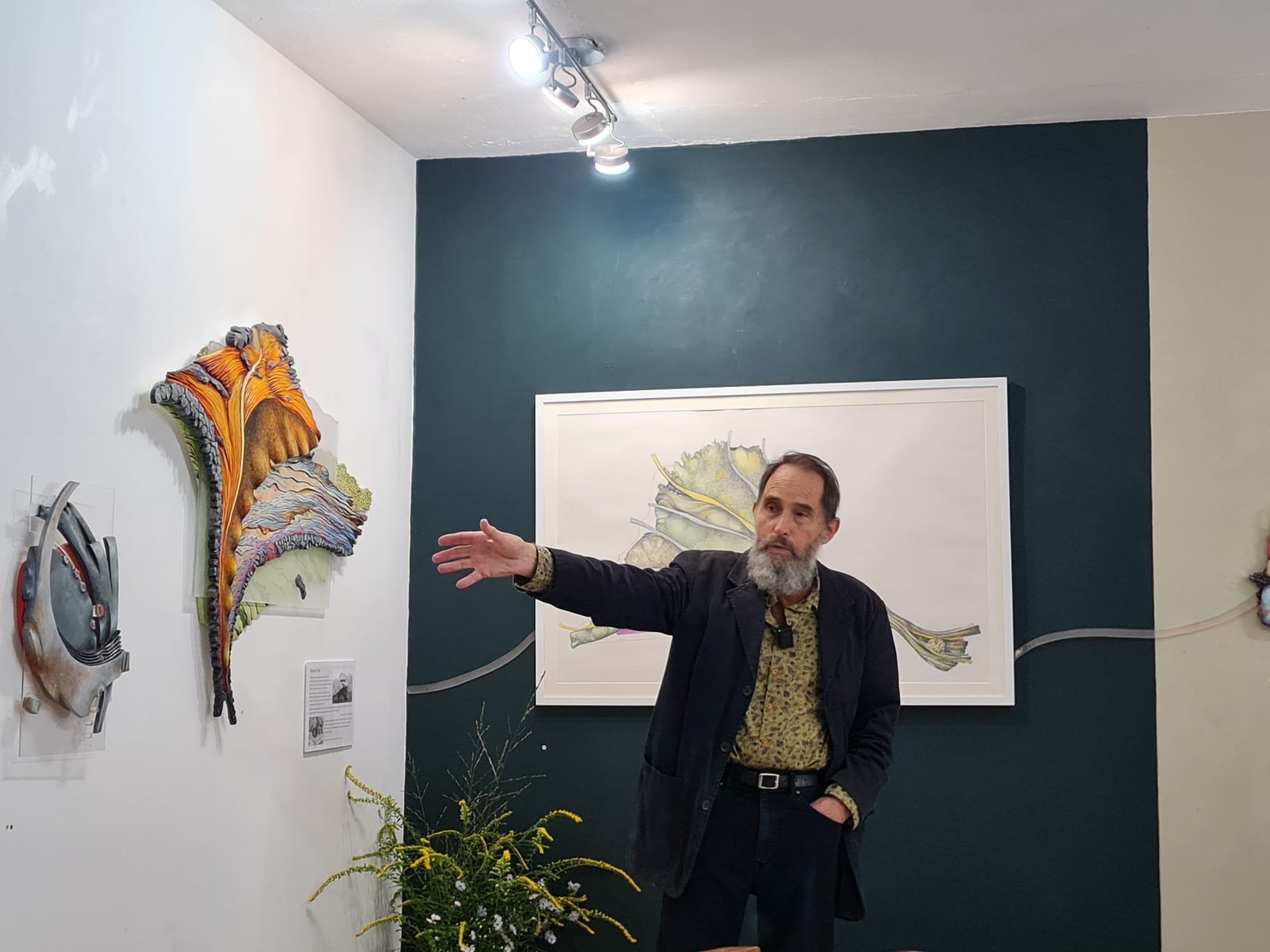
Pete talking through the landscape forms within his work at Terre Verte Gallery.
The resulting pieces feel somewhere between landscape, map, geology and living form. They are layered and textured, with lines moving through them like waterways, pathways or currents of energy.
Some feel almost anatomical.
Some feel geological.
And some begin to feel distinctly creature-like.
Which brings us back to the dragon.
When the landscape becomes a dragon
This was the part that particularly resonated with me.
Across cultures, dragons are repeatedly associated with earth, water, power, guardianship and particular places in the landscape. We find them linked with hills, ridges, rivers and sacred sites, and often with the movement of powerful forces through the land.
Sometimes that relationship appears in mythology. Sometimes it emerges through the shape of the terrain itself.
You look once and see a hill.
Look again and there is a spine.
Then perhaps a head, a folded wing, or a creature stretched across the land.
Is that pattern recognition? Imagination? Mythic memory? Energetic perception?
Perhaps it does not have to be only one thing.
I find myself less interested in proving whether a dragon is literally there and much more interested in what happens to our relationship with the landscape when we begin to perceive it in that way.
Because something changes.
The landscape stops feeling passive.
It becomes animate.
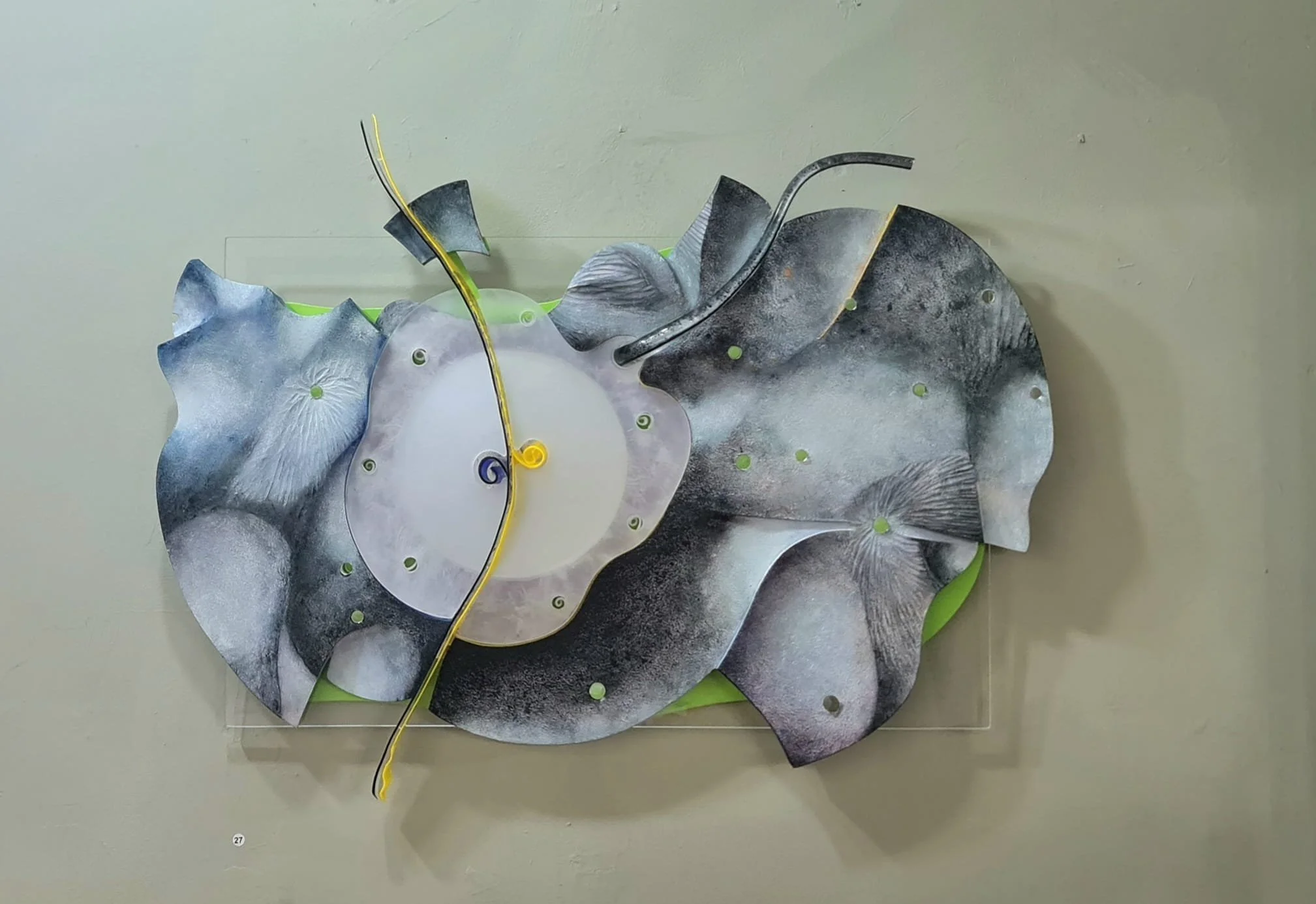
Langstone Downs centre cairn by Pete Bousfiled
Geology, water and earth energy
One of the other things I found fascinating in Pete’s work is the meeting point between the physical landscape and the energetic one.
Earth energies can sometimes be talked about as though they exist separately from geology, but the physical landscape is already full of movement.
Rock fractures and folds. Underground water follows routes through stone. Springs emerge at particular geological boundaries. Faults, minerals and waterways shape the land over extraordinary spans of time.
Then human beings come into that landscape and place stones, wells, circles, trackways and ceremonial sites within it.
It seems entirely reasonable to wonder whether some of those things may be related.
That does not mean every pattern needs to become a theory or every correspondence needs an explanation. Sometimes the most interesting thing we can do is simply notice.
Place one layer over another.
See what appears.
Dowsing can offer another layer of enquiry within that process. Not necessarily certainty, but another way of listening.
Art as part of the enquiry
What I also loved about Pete’s work is that the artwork does not simply illustrate his research. It feels like part of the research itself.
Walking is part of the enquiry. Dowsing is part of the enquiry. Drawing is part of the enquiry. Making the sculpture becomes another stage of it.
Then the finished artwork allows somebody else to enter that process too.
That is quite different from presenting a diagram and saying, "Here is the answer."
Art is very good at holding uncertainty. It can suggest rather than explain. It can allow several things to exist together without forcing us to choose between them.
A piece can be a map, a landscape, a geological structure and a dragon all at once.
Perhaps that is one reason this work feels so appropriate for exploring earth energies. It leaves space for what we know, what we sense, and what we have not yet quite found words for.
Perhaps the dragons were always there
What stayed with me after Pete’s talk was the idea that the more attention we give to a place, the more layers it can reveal.
At first we see a hill, a tor or a stone circle. Over time we may begin to notice the geology, the water, an ancient alignment or a relationship between places.
And then, perhaps, we see the creature lying underneath it all.
I do not feel any need to pin down exactly what the dragon is. I rather like leaving that question open.
Dragons, whether we encounter them through myth, art, dowsing, imagination or the landscape itself, invite us to look again. They ask us to notice what lies beneath the obvious surface of a place and to wonder whether the land is something more than a backdrop to our lives.
Perhaps it is something we are in relationship with.
And perhaps, sometimes, if we slow down enough and keep looking, it shows us the shape of the dragon.
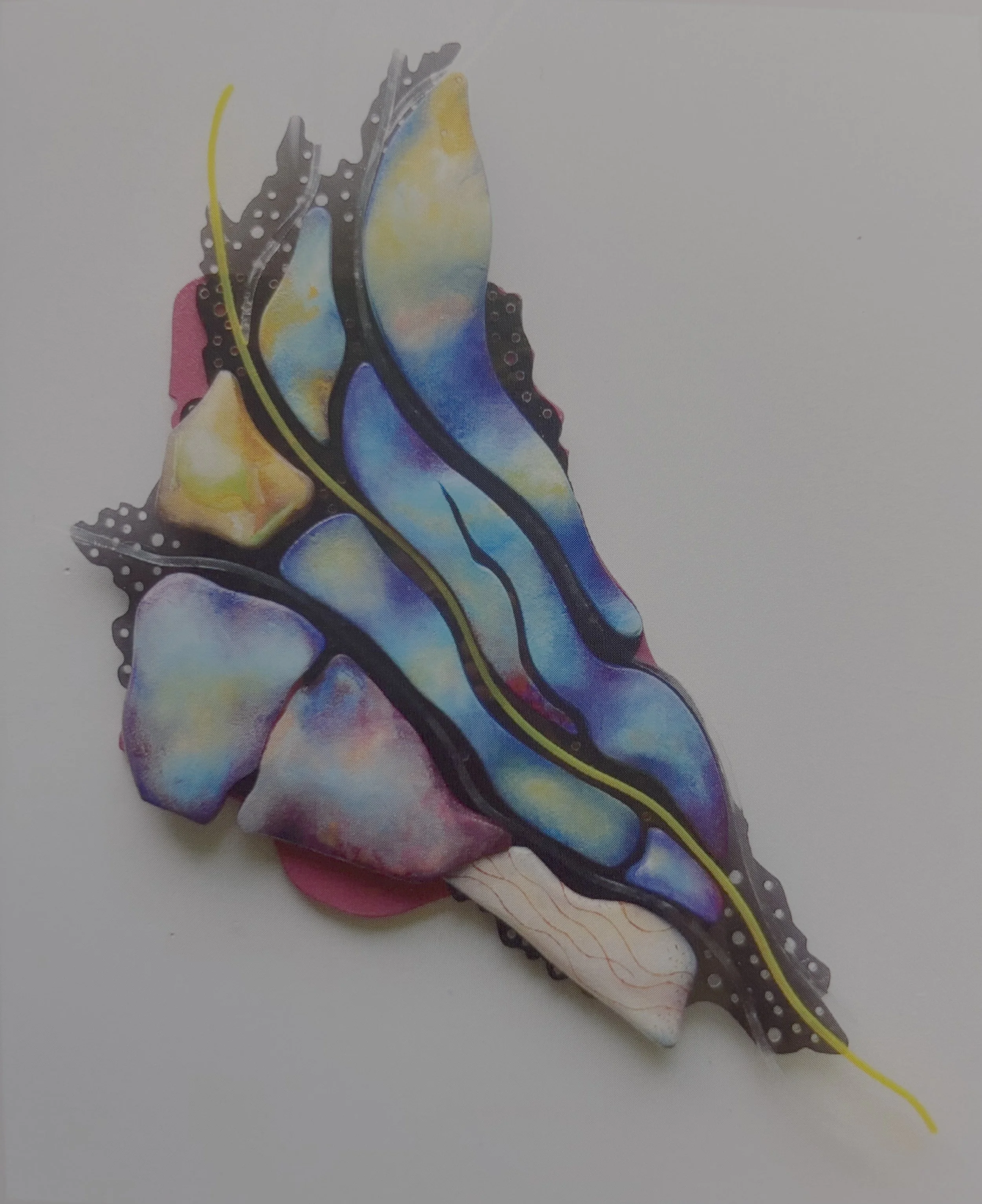
Is it just me, or does this remind you of a Dragon’s Head? Artwork by Pete Bousfield, “Ravens Drinking, Water”
See the work
Pete Bousfield’s exhibition, The Dragon’s Back - and other stories, is showing at Terre Verte Gallery in Altarnun, Cornwall, with its final public day on 3rd October 2026.
The exhibition brings together Pete’s sculptures, drawings and the landscape and dowsing explorations behind them.
We also recorded Pete’s Tamar Dowsers talk, where he shares how the work developed and takes us through some of the places and discoveries that inspired it.
Watch Pete Bousfield: The Dragon’s Back - and other stories:
Exploring dowsing, consciousness, creativity and our relationship with the living landscape.